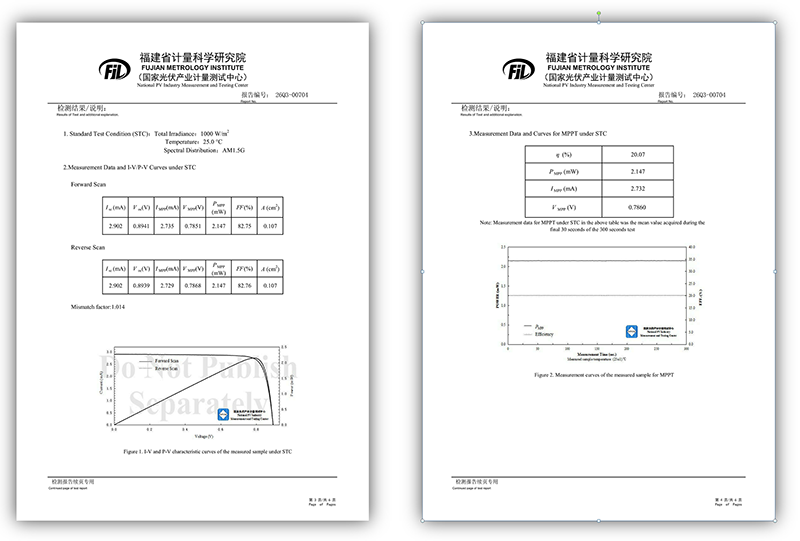
Researchers from National Center for Nanoscience and Technology (NCNST) in China and Hyper PV Technology Co., Ltd. fabricated an organic photovoltaic (OPV) cell that achieved a certified steady-state efficiency of 20.1% with a cell area of 0.107 cm². The certification testing was conducted by the Chinese National Photovoltaic Industry Measurement and Testing Center (NPVM). The steady-state efficiency in this work represents the highest certified steady-state record for single‑junction OPV cells to date.
The team developed this high‑performance OPV cell using a ternary blend strategy, combining the commercially available polymer donor D18, the nonfullerene acceptor L8‑BO, and a newly synthesized narrow‑bandgap acceptor, Qx‑Se‑NF, which was designed and synthesized in the NCNST lab. The excellent device performance based on Qx‑Se‑NF has been published in Nature Materials (Nat. Mater. 25, 1614–1622 (2026)).
The molecular design of Qx‑Se‑NF integrates three key structural elements: the central quinoxaline (Qx) unit with low reorganization energy, naphthalene‑fused end groups (NF), and a selenium (Se)‑substituted central backbone. The NF‑fused end groups not only enhance electron delocalization and intermolecular interactions, leading to a red‑shifted absorption spectrum, but also suppress conformational changes caused by molecular distortion, thereby reducing both reorganization energy and energetic disorder. Meanwhile, the Se substitution in the central backbone effectively restrains molecular twisting, lowers energetic disorder, and strengthens intramolecular charge transfer, significantly broadening the absorption spectrum. As a result, the Qx‑Se‑NF‑based OPV devices overcome the typical energy‑gap law limitation of conventional narrow‑bandgap molecules, enabling a synergistic improvement in both short‑circuit current and open‑circuit voltage.
In the certified measurements, the cell exhibited an open-circuit voltage (VOC) of 0.894 V, a short-circuit current (JSC) of 27.12 mA/cm2, and a fill factor (FF) of 82.8%. The cell maintained a stable state during the Maximum Power Point Tracking (MPPT) test. The relative fluctuation of the output power of the OPV cell was less than 0.1% over a total test time of 5 minutes. Chi Zhang, a doctoral student at NCNST, Jing Tao, a postdoctoral research assistant at NCNST, and Jin Fang, an engineer from Hyper PV Technology Co., Ltd., mainly carried out the certification work.